
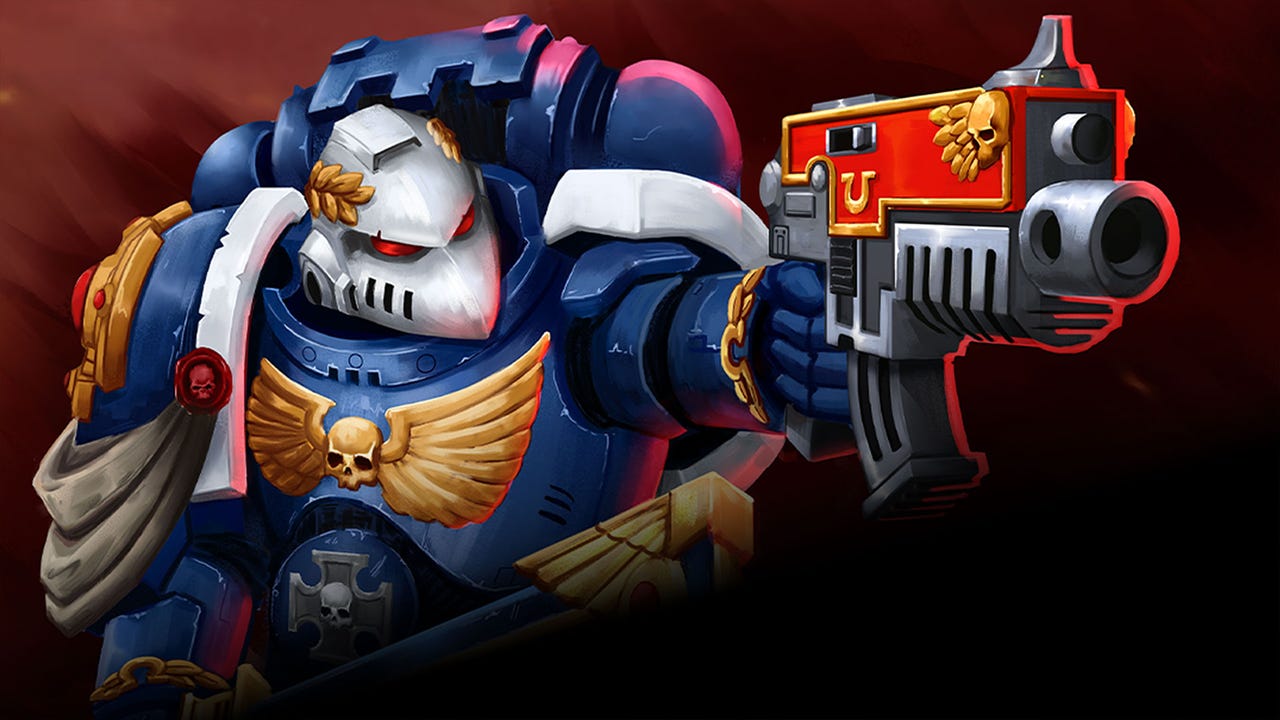
If you were making a sequel to Warhammer 40,000: Boltgun and wanted to inject a bit of extra boom into the boomer shooter, then you probably wouldn’t look any further than Mick Gordon. The legendary Aussie composer has been soundtracking videogames for about two decades, but it was his face-melting work on 2016’s Doom and 2020’s Doom Eternal that really established his monster guitar riffs as the perfect way to fire up fans of first-person shooters. It seemed a no-brainer, then, that developer Auroch Digital would enlist Gordon to add his signature heavy touch to the climactic boss fight at the end of Warhammer 40,000: Boltgun 2. Ahead of the game’s release this week, IGN caught up with Gordon to get an insight into how his curtain-dropping contribution to the shooter sequel’s soundtrack came about.
IGN: How did you come to be involved with Warhammer 40,000: Boltgun 2? Were you familiar with the first game?
Mick Gordon: Yeah, definitely. So, I sent the team an email after the first Boltgun, and I said, “Hey, this game is really cool. There are a lot of boomer shooters out at the moment, but I think what you guys have done with it feels really good. It feels really fun to play. And you’ve obviously combined this pixelated, sprite-based, first-person shooter boomer shooter thing with the Warhammer 40K universe in what seems to be the most obvious idea that nobody else had ever thought of. Really, really great job.”
So, I had a bit of a relationship with them from that moment. And when they were doing the sequel, they shot me an email. They’re like, “You know what? We’ve got this giant boss battle at the end, and it’s on a scale that did not appear in the first game, and we want to have some music for it that kind of matches that scale, something that’s really big and bombastic and silly. Would you like to do it?”
And of course, I was like, “Yeah, I’d absolutely love to.” I’ve always wanted to, but I’ve never been involved in the Warhammer universe. I’ve always wanted to stray into that territory, but I’ve never [been] given an opportunity to until this one came along. So, there’s the first-person shooter aspect, there’s the Doom-inspired first-person shooter aspect, there’s the pixelated aspect, there’s this giant evil-looking demonic battle boss battle thing, and then there’s the Warhammer thing. So, I mean, how would you not say yes to that? It’s like a match made in heaven, really, isn’t it?
IGN: When something like this kind of falls in your lap, do you start completely from scratch or do you have a folder on your MacBook that’s labelled “Sick First-Person Shooter Riffs” and you just kind of scoop some of those out and start sculpting with them?
Gordon: No, definitely not. My job on every single project is to try to come up with a unique voice that suits that project and that project only. I like to think about these things as something that I come up with exists in a sphere in the universe, and that sphere belongs to that thing and that project, and that is unique in that space. When I’m coming up with something else, I can’t push that sphere into the space that that other sphere exists in. Do you know what I mean? I have to come up with something that takes up its own space.
Now, of course, people will say, “Well, we’ve listened to your music. It sounds like you did this, sounds like you did this, you did this.” I know you can never completely divorce yourself from your own tastes and input. So, I understand that. But my goal is to try and work with the team to come up with something unique that fits the music’s purpose for that specific project alone. So, I don’t just have like a bunch of [pre-existing] riffs or ideas that I would put into this game, and this game, and this game. That’s not my job. My job is to sit with the team and try to find what makes their thing unique and really just explode that out [in an] extreme sort of way musically.
IGN: As part of your process for creating your track, ‘Ascent of the Arkifane’, did you actually play the boss battle itself?
Gordon: It can be difficult because often games aren’t fun to play until they are finished and ready to release. You know what I mean? And often because of the rapid development on these games, there are builds being done several times a day. So, it can be very difficult for a team to send me a stable build to actually work with.
Instead, what they do is send me capture footage that the QA department puts together for me. And the QA people, it’s their sole job to play the game all day. So, they are really good at it, and they’re really good at making it look like it’s how it’s going to be. And that’s perfect. That’s all I need. They will send me that. They will send me screenshots. They will send me concept art. I will have conversations with the developers and things. But I love videos. Videos are the best.
Why I love the videos is I take the video when I get it in my studio, and I put the video on my television, and I sit on my couch, and I have a controller in my hands that is not even plugged in, right? It’s just there, and I sit back on my couch and I start imagining myself as a player playing the game for the first time. The reason I’m doing this is I’m trying to find the most perfect tempo for what the music should be to match what I’m seeing. Then I have a little metronome app on my phone which is sitting on my thigh, and I will literally tap metronome tempos and write them in a notebook and say, “This level needs to be 99 beats per minute. This level needs to be 138. This one needs to be 216 beats per minute.” And the whole reason I’m doing that is to try and find a tempo that fits with the natural pace of the gameplay itself.
I have to do that because if the music I make is too fast, it becomes overwhelming and annoying to the player. At that point, players go into the options menu and they turn the music down or off. And if they’re doing that, I have completely failed. Not just at my job, but at life in general. If my music is too slow, that can result in reviewers saying, “This game feels sluggish. This game feels slow. The game itself didn’t quite feel exciting.” You know what I mean? That even if the game is tight, even if the game feels really good, the mechanics are there, everything is really nice and polished, if the music is too slow, the whole experience can feel really sluggish, you know?
So, my job is to just find the right tempo. Once I’ve got the tempo, then everything can get built from that point there. I set everything in my studio up to that tempo, and then I start building ideas out to match the game itself.
IGN: Once the developers of Boltgun 2 have given you artwork and gameplay videos, do you just lock yourself in your studio and produce the track on your own? Was there much back and forth with the development team?
Gordon: It’s definitely a back and forth thing. I mean, you’ve got to understand when I start working on a project, there’s nothing. Nothing exists. It’s a complete blank canvas, you know? I don’t even have a sharpened pencil at that point. It’s nothing. And I get nothing for free. Like nothing. Nobody comes along and says, “Make this in D minor at 90 beats per minute” or whatever. Nothing. Nothing at all.
I have to experiment. I have to try. And I’m very big on finding teams and people that I love working with that I can feel comfortable in failure with. So, when I am submitting an idea, I have more confidence in myself submitting an idea that might be a stupid idea or might be an extreme idea. It might be a crazy idea because I need the team to be able to start saying yes or no to certain things. It’s definitely a collaboration that I have with them. Like anybody does with a computer-based setup, [I have] millions of possibilities. I can do anything. I can do an entire video game score on [a] laptop if I need to. Anything is possible these days.
What happens with that freedom is choice paralysis. There’s a million different decisions that need to get made all the damn time. And when I’m faced with a branching path between decision A or decision B, I need a deciding factor of which way to go. Now, I can do a lot of that on my own end, for sure, with my own taste, my own input, but at some point I’m going to need to say to somebody who’s a lot closer to the project, who’s been on it for a number of years, “Hey, do you prefer A or B or C or D or A,” whatever it is.
So, there’s definitely that back and forth process, and I love that, too. I love that because it starts involving them, and they start feeling like they’re part of the music, and their input starts developing and shaping the song as a whole as well.
IGN: Is it a unique challenge to be tasked with specifically soundtracking what is effectively the climax of the game? Where your job is to basically push the peak of the player’s experience to its absolute limits?
Gordon: It is, but it also taps into this rather unsavory part of my personality, which is the desire to walk into a room and be the absolute most arrogant bastard in the place. And when we’re in the final boss battle, I can walk in and be the loudest, most obnoxious bastard in the room.
IGN: That sounds like fun [laughs]. Is it also somewhat bittersweet in another sense, given that your music isn’t featured until the end of Boltgun 2, and statistically that’s likely to be a point that only a fraction of the audience will actually reach?
Gordon: Yeah, that’s a really good point. When I make this massive game score, I know that there’s a large percentage of players that are never going to hear this little bit of music. There’s music I have in games that I know from even Doom and stuff that people have never, [or] very rarely even heard. The whole Rip & Tear track, for example, is about 28 minutes long. The version that sits on the album is what, three minutes or something like that? I had to cut out so much stuff just to fit it on Spotify. There’s so much to it that people will only hear if they do something really specific and really unique.
But I love that, too, because I love that feeling that I had when I was playing games as a kid of finding a hidden area or finding something secret. It made it feel like I had a closer relationship to the game, you know? It felt like it had a little secret thing, and I knew that little secret now. [It meant that] the game and I now had a bit more of a deeper relationship, you know?
And so I love the fact that there’s only going to be a small percentage, and it is—when you look at the actual numbers on Steam or whatever, it can be like 6% of people get to the boss battle. It’s crazy, [but] I don’t care. I love that. I think that’s actually really cool because for those 6% of people that will get it, they’ll get something that’s specific and unique. You know what I mean? And I get to build a relationship with that player that the rest of the population doesn’t have. I think that’s really quite special.
IGN: Speaking of Doom, your work on that series was so remarkable because it became something beyond merely background music, it actually had an active influence on the player. Like the rhythm of the music basically dictated the rhythm of the action and vice versa. It was like a perpetual motion machine. Is that the absolute ideal for you? That your compositions will literally ride shotgun with the player?
Gordon: Yeah. The term I like is “forward momentum.” I love that games, I feel, are the only art form where there is a direct link between the audience and the art form itself. If I’m in an art gallery, there is a gap between the canvas and me, the viewer. If I’m watching a film, there is a gap between the film itself and me sitting on the couch. But a game only works if you, the player, are interacting with it. Without that, the game is useless. It doesn’t do anything. It needs your input.
So, there is this cyclical thing between you and the game. This cycle that you work back and forward. The player is a collaborator. It’s very important. If you take out the player, the game doesn’t exist. It’s absolutely useless. You need that. So, I’m always trying to think about how that works.
Now, it doesn’t just work philosophically. It works on a technical level. My music for a game is essentially a three or a four or a five-hour song. It’s one song. It exists in one session. That song gets broken up into multiple little segments that then get rearranged based on what the player is doing. If the player is low on health, if they’re into the next level, if they’re fighting a boss, if they’re doing really well, if they’re not doing really well, if they’re in a tutorial… Whatever it is, if they’re playing with their friends, the music will change based on what they’re doing. They are literally in control. They’re the conductor. So, there is always going to be that relationship between what I’m doing and the player. That’s absolutely super important. And that’s always in the back of my mind. I can’t escape it. That is literally the nature of video games.
IGN: Thank you very much for your time.
Warhammer 40K: Boltgun 2 is out now on PlayStation 5, PC, and Xbox Series X|S, with a Nintendo Switch 2 version to be released at a later date. You can check out IGN’s review of the retro-styled first-person shooter sequel here, where we gave it 8 out of 10 and declared it was “an explosive sequel that packs a bloody punch.”

Tristan Ogilvie is a senior video editor at IGN based in Sydney, Australia. He has 25 years of experience covering video games, having served as Deputy Editor on Official PlayStation 2 Magazine Australia and as Editor of Official Xbox 360 Magazine Australia, before joining IGN in 2009. You can find him on Bluesky @tristanogilvie.bsky.social