
The wait is finally over for Riftbound’s Vendetta booster set, as its release is now just around the corner. This will be the League of Legends TCG’s fourth big drop with pre-release events at local stores starting July 24th with the global release on July 31st. That’s right! With the game having about a year under its belt now, fans finally have a synced-up release with both English and Chinese languages for the first time. Not only is this great for the meta, but players will also have some new deck combinations to mess around with as the set introduces new legends with opposing colors or domains and, of course, new mechanics like Flow to give some extra options out of hand. Not to mention, some overnumbered cards are getting a sleek take on rivalries, with diptychs or cards that can be displayed side-by-side to show a full art piece. From what I’ve seen so far, Vendetta is looking to be a fun set as players get deep into deck brewing with what could be one of the freshest meta for the game to date.
With new keywords brings some form of power creep, so I wouldn’t be surprised to see new staples in every deck of this upcoming meta. First and foremost, there’s the Flow keyword, which allows players to play cards from their discard pile and remove them from the game. This is great as a surprise move if opposing players forget to check what’s in your trash. Even then, it’s a good threat to have even if they are paying attention. Either way, it’s an easy way to keep your options open if your hand size gets too small. As long as you have enough resources to pay the cost, Flow can really turn the tide of a showdown. For example, the signature spell Public Execution allows the player to kill an opposing unit if it has less might than a chosen friendly unit for the spell. When it’s in the discard pile, you can pay the heavy cost of five runes and recycle two runes to play it again and remove it from the game. Playing from the discard is a huge advantage, so it makes sense that they never stay in the discard pile after use in that way. The Public Execution spell is a signature of the legend Ambessa, and one of her new champion units, Ambessa The Wolf, fits with this quite well. If empowered or upgraded, Ambessa The Wolf gains +3 might and can’t be dealt damage unless in combat. With a total might of seven, Ambessa at base can use Public Execution to safely take one unit out of the equation during showdowns as other units go on the offensive. Whether it’s to conquer or defend a battlefield, using cards via Flow are game changing.

Speaking of Empowered, it’s another new keyword that enables the upgrade of certain cards for the rest of the time that they’re on the field, unless otherwise reversed or negated. For instance, Helm of Suppression is a gear that can be empowered with a cost of 4 runes and one calm recycle. Its basic form applies a one-rune tax to opposing players’ spell cost, but when Empowered, it adds an additional tax of one rune recycle. That’s pretty devastating when spells are so often used to support units during a showdown. If not careful, players can be greatly limited in their options as long as an opposing Helm of Suppression stays on the field. Not to mention, it seems to be rare to disempower gear specifically so players will need some gear removal if you want to tech against this taxing helm. Another cool card showcasing Empowered is Kharox. When Empowered, an opponent Burns or discards three cards from the top of their deck. After doing this, the owner of Kharox may play a unit in their opponent’s trash onto the field while ignoring its cost. So essentially as the Kharox player, you’re rolling the dice by forcing cards into your opponent’s trash to then steal control of one of their units. If you’re lucky, you might be able to steal a 10 cost/10 might Corrupted Dragon in your favor. Empowered has some really cool effects with some cards gaining powerful passive abilities, while others have strong one-time uses for every instance of being Empowered.
That leads us to the last new keyword briefly mentioned already, Burn. For the most part, it goes hand-in-hand with Flow, since players need cards in the trash to even use Flow in the first place. With this keyword, a typical TCG player’s mind would go to a mill deck, but running out of cards in a deck is not a lose condition in Riftbound. Instead, running out of cards in a deck initiates a Burn Out, where the player shuffles their trash back into their deck and awards the opposing player a point. In some ways, a mill deck could win, but it’s not instantaneous like other TCG games. With that said, Burn seems to be most fitting with purple/chaos decks like the new Kennen and Zed Legends, since those chaos cards tend to have discard and now Burn. Red/Fury is also another consistent route to get more cards in your trash, with past cards already allowing discard. If you choose to only use one of these domains for a Burn/Flow deck, the Shadow Temple battlefield is helpful with Burn 3 if you hold it. These keywords have been quite fun to strategize around with so far, with Burn and Flow being the most impactful based on my experience.
Looking ahead to the upcoming meta, the most exciting part is having global players all on the same footing as we get into the new cards this competitive season. No longer will delayed regions get the benefit of seeing what’s best in China and capitalizing on that success when the English language cards are released. That’s part of what leads to bans in some cases, which means fewer cards and decks for players to enjoy by the time a new set releases in their region. At least now, players will get to enjoy all the new cards equally and figure out the best decks for some time before the Riftbound team even considers any kind of impactful action like bans or restrictions. That’s what makes a new set of cards so thrilling. Having folks print out proxies from the initial spoilers to deep testing of new decks up until the first few tournament events is where competitive players thrive. As time goes on, everyone else catches on what works best, but it’s hard to beat the experience of piloting these new decks for a longer period of time.
With that said, some top decks from the last set still always have a good chance of appearing so soon after a new set releases. Like I mentioned, experience and comfortability goes a long way, especially when a tournament is on the line versus playing a completely new deck that’s not nearly as tested. Based on the bigger recent tournaments, the Irelia Blade Dancer deck of purple/chaos and green/calm is one of those tried and true decks that can make top cut. The deck thrives on movement alongside some counterspell and survivability with the low unit count. Looking at the new Vendetta cards, spells like Twilight Step and Resonating Strike allow for further movement of units, which the deck likes to do. Since Empowering is new, the deck could tech in a Sanction spell just in case to disempower any annoying units. Units-wise, we don’t want to add too many new ones considering this is a spell-heavy deck, but a sticky unit like Akali Silent, who can’t be targeted by spells or abilities unless in combat, is a good choice. Kennen Storm of Shuriken is also a possible add, with all the potential spells that could be given Flow for further options out of hand. Tweaks like this still keep the deck competitive without sacrificing too much of what makes it perform.
Another deck that sees top cut action is Master Yi, Wuju Bladesman with green/calm and orange/body domains. Similar to the Irelia Blade Dancer deck, there are the usual green counterspells, the sticky unit Irelia Fervent, and the helpful Scuttle Crab in the Master Yi deck. The differences, of course, are the orange/body cards like Rengar Trophy Hunter, Master Yi Tempered, and pumping orange spells like Punch Fist. Another perk of the deck is defending battlefields with one unit alone with the +2 might passive from the Master Yi Legend. So with the Vendetta cards, units like Gangplank and Renekton might be worthwhile additions. Gangplank, an IGN exclusive reveal, becomes harder to remove from the field when he’s Empowered. Single-targeting him becomes limited due to the effects he can nullify, which can be quite annoying to play around. For Renekton, he becomes Empowered when he becomes 10 might or more. With the Master Yi buff of +2 might when Renekton is defending alone, he’s only four might away from ten, which is a simple jump with orange/body spells. As for spells, having another buffer with Onslaught is also handy in orange, plus it has a Flow cost to boot for an additional use. Cataclysmic Duel is another great addition that works as a board wipe, but also leans into the solo-defender strategy of Master Yi by allowing both players to save just one of their units. Overall, these top-tier decks have some nice new tools to tinker with in the upcoming competitive season.
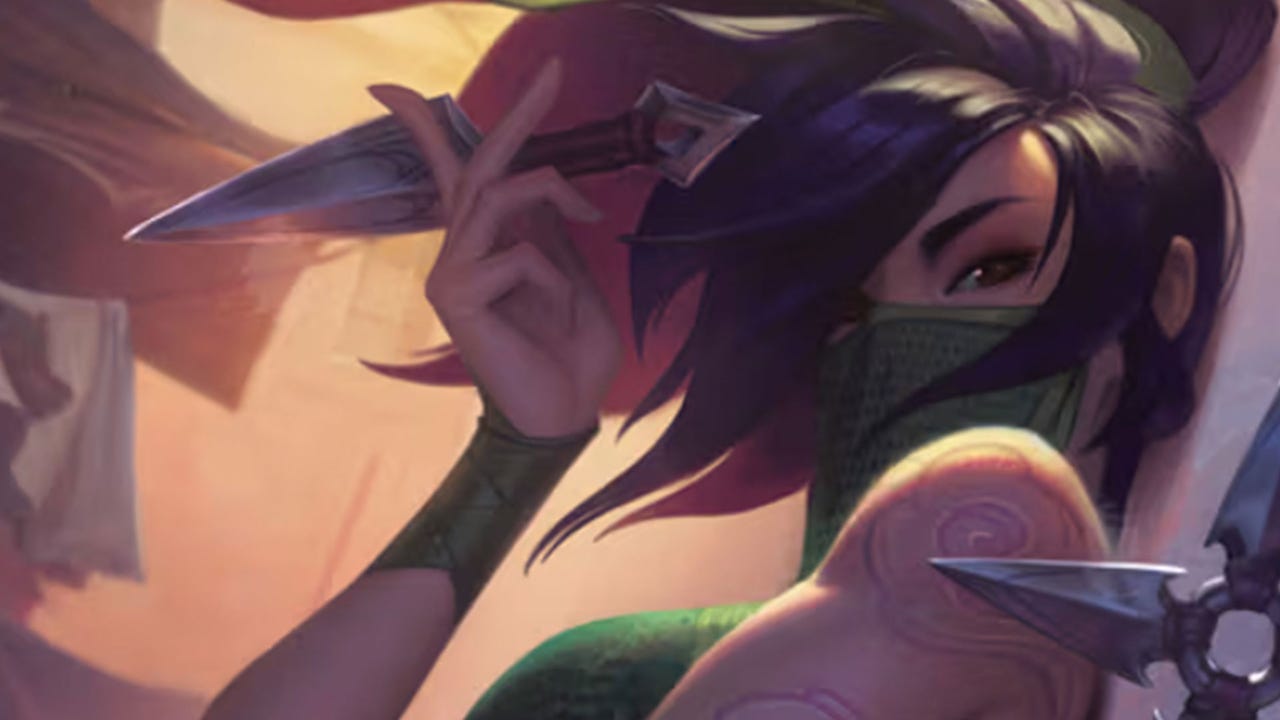
As far as completely new decks coming out of this set, the newly introduced leaders with opposing domains are intriguing to build around. Not just because they’re new, but because the domain/color combination wasn’t possible before they existed. The one that grabs my attention the most is Akali Rogue Assassin with red/fury and green/calm domains. When I first played the game, I really enjoyed the movement of the Yasuo decks. Now we have decks like Irelia, which are the best form of this kind of archetype so far. With Akali, I can attack with the champion unit Akali Deadly Weapon to ping damage to then move back to base to possibly swing in again to shoot additional damage. It’s kind of like kiting in League of Legends, which lines up with what the designers sought out to do when figuring out Akali’s playstyle – as we learned with our chat with Riot. Besides the green/calm cards that can move or buff, the access to red/fury cards means buffing with Assault on attack or ping additional damage with its spells. Combined with Akali’s poke and retreat strategy, the new Legend deck is what I’m looking forward to playing the most.
Of course, we have to highlight the beautiful new art on these cards. In addition to the usual overnumbered variants and new Legends to the card game, Riftbound is getting diptychs for the first time, showcasing certain rivalries. This means two cards that can be put side-by-side to show a larger art piece or scene. The set introduces 22 of these rivalry variants, meaning there are 11 sets of diptychs to chase for and admire. It’s a nice addition to an already visually stunning game. Between the signature variants to the various costumes or skins that each Legend can pull from, there’s a whole library of new art that the Riftbound team can make use of. For example, another addition is the new Crystal Rose variants celebrating the art from Wild Rift, the League of Legends mobile game. There’s a lot more art to love this set, so both players and collectors have much to chase for.
Between the new additions in gameplay – from the keywords and Legend color combinations – and the beautiful art, Vendetta is looking to be one of Riftbound’s biggest sets yet. Plus, the first global release sync is such a big sigh of relief for competitive players which means a fairly healthy meta throughout the length of the Vendetta competitive season. For more on Riftbound, check out our hands-on impressions of the two player pre-constructed kit, Zed vs. Shen Showdown Decks, and also our interview with Riftbound senior designer Jon Moormann about some new Vendetta Legends.
Mike Mamon is a Syndication & Digital Specialist at IGN, devil fruit user, and world-renowned JoJo poser. Let’s chat anime or TCGs on Bluesky @xpmnms.bsky.social