
Polish developer Rebel Wolves has worn a confident face since it first revealed The Blood of Dawnwalker early last year. The blood-soaked reveal trailer featured a gorgeously grisly cutscene, an unmistakably Slavic score, and a snapshot of a sprawling medieval open world. Crafted by many of the minds behind The Witcher 3, including its director Konrad Tomaszkiewicz, everything we’ve seen since has effectively proclaimed that this new vampire RPG intends to fight in the same league as CD Projekt Red’s best.
My recent visit to Rebel Wolves was something of a proving ground, then. Until now, all access to The Blood of Dawnwalker had been hands-off. But for this IGN First demonstration I’d be playing for four hours straight, beginning with selecting “Start New Game” from the main menu. 240 minutes later, my long-held feelings were (mostly) confirmed: The Blood of Dawnwalker has plenty of that Witcher magic, but it fuels something with its own equally interesting identity.
By starting from the game’s very beginning, the first three hours of this demo covered much of the same ground as my previous hands-off preview. Protagonist Coen lives a small-town life in the Carpathian valley of Vale Sangora, an area ruled by vampires who have freed the people from plague and taxes in exchange for a monthly blood tithe. The next is due tonight, and Dawnwalker’s approach to time – there’s only so much of it, represented by a sort of “currency” you spend to push quest forwards – means you can only complete so many objectives before the ominous Blood Mass begins. But playing this prologue on my own terms allowed me to explore much more of Coen’s village than I’d seen before, and even rearrange the details of his story.
blood and love
Whatever Rebel Wolves had shown me previously, I did the complete opposite. This began with Gremla, a distraught woman whose cries had been ignored during the hands-off. She’d been sewing a tapestry banner in honor of the vampires’ leader, Brencis, and it was due to be displayed at the evening’s Blood Mass. But it’s been stolen. Thus begins what is effectively a tour of the village, introducing a number of characters who would otherwise have blended into the background as you interrogate suspects, cross-examine their statements, and use a focus vision ability to assess footprints and trails. As a tutorial quest, it’s practically on-rails, bouncing you from villager to villager as you narrow down the guilty party, but it’s a clear demonstration that, like Geralt before him, Coen will need to play detective from time to time.
After narrowing down the clues, I find the thief, and as you’d expect from designers who previously worked on The Witcher, there are complications. Tired of enduring vampire rule, this otherwise humble laborer stole the banner as an act of rebellion. The fabric is woven with images that, in days gone by, would be considered heretical to hang in a church, but now the town does so willingly. It’s hard not to sympathize with his cause, but to let him get away with it surely means a miserable punishment for Gremla. Fearing for the old woman’s life, I take back the banner. It’s hung in the church, and the “peace” with our overlords is kept. Does this make me a hero, or a coward? I suspect many of Dawnwalker’s difficult questions – and the consequences they manifest – will eventually make it clear.
While The Blood of Dawnwalker makes no distinction between “main” and “side” quests, the prologue does have a storyline that feels more critical. A quest that tasks me to find medicinal herbs for Coen’s sick mother takes me to the house of Anca, a local witch who appears destined to become one of Dawnwalker’s romantic options. While the writing is strong across the whole breadth of this preview demo, the dialogue between Coen and Anca is notably well crafted. There’s genuine affection between the two, delivered without ever dipping into corniness or obnoxious flirtation. As I dig deeper through the quest’s dialogue trees, Anca makes multiple references to being an “old woman”, despite looking no older than 30. It’s a subtle combination of both character and worldbuilding – plague and hardship mean no one lives long around here, and Anca’s role as the local healer has made her wise beyond her years.
A sudden storm forces the two of us inside, and I’m given the option to spend extra time with Anca by studying her books. I cannot be late for the evening’s Blood Mass, and so I only have the daylight hours to complete Coen’s chores – a period represented by a HUD element split into eight segments. Most of the prologue’s quests consume one segment, but choosing to extend my stay with Anca will effectively double the cost of this task. I was already fascinated by Dawnwalker’s “time as a resource” system, but it’s here where I can really see how it will demand interesting choices from us. Is it worth spending time that could be utilized elsewhere to deepen my relationship with a paramour? For now, I entertain Coen’s awkward infatuation, and even invite Anca to study some salacious literature with me. Perhaps this means I won’t have time for a quest that provides a more significant material reward later in the day, but love never did come without sacrifice.
With a pocketful of herbs and a heart full of butterflies, I leave Anca’s storm-ravaged hut and head back home to administer the remedy to Coen’s mother. Completing the task has a significant impact on the prologue – it doesn’t exactly branch the narrative, but the resulting events in my demo are notably different to what I witnessed in the hands-off. It’s all too significant to spoil here, but it seems like Rebel Wolves has found a way to change the story’s stakes and Coen’s emotional connection to them without having to totally rewrite The Blood of Dawnwalker’s core plot. I suspect some players will perceive this as a bit of narrative trickery that makes no genuine impact. I’ll reserve such a judgment until I see how the outcome of this quest ripples through the whole campaign, but for now I feel pretty positive about how the consequences of your actions are handled here.
Death Valley
By the prologue’s end, Coen has become the titular Dawnwalker – a man by day, a vampire by night. And with the first elements of his toolset unlocked, I’m thrown into the open world of Vale Sangora. From what I can see, the valley is large without threatening to overwhelm. There’s a lot of ground to cover – which you can do so by magically increasing your run speed during the day or by transforming into a wolf when the moon rises – but the world doesn’t appear large enough to turn this into a Skyrim that you’ll be exploring for hundreds of hours over multiple years.
In terms of atmosphere and general approach, unsurprisingly the closest comparison point is The Witcher 3, but my hour-long taste of the world suggests it may operate a little differently. My first port of call is a crumbling brick tower, which poses a simple climbing puzzle to reach its peak. There, with the horizon in clear view, I’m able to survey the region for points of interest. It’s a little Ubisoft-ish, and while I don’t believe that’s shorthand for a rote open world, there is at least some of that tried-and-tested loop to how you explore Dawnwalker’s world.
It also seems like there’s a number of open world “activities”, as opposed to everything being quest-driven. For instance, I stumbled across a luminescent wisp that led me to the scene of a lovers’ death atop a hill – a little bit of environmental storytelling offered as a reward for defeating the mound’s grizzly bear guardian. On a roadside, I butchered some soldiers who were transporting barrels for their vampire overlords, disrupting the supply chain. In the depths of a swamp, a miniboss battle pitted me against a leaping undead creature that could fire projectiles with its scream. None of these captured my interest in the same way the prologue’s narratively-driven storylines did, but that’s not to say they’re of poor quality. Provided these ideas aren’t repeated too frequently across each region, I can see them adding welcome texture to your task list.
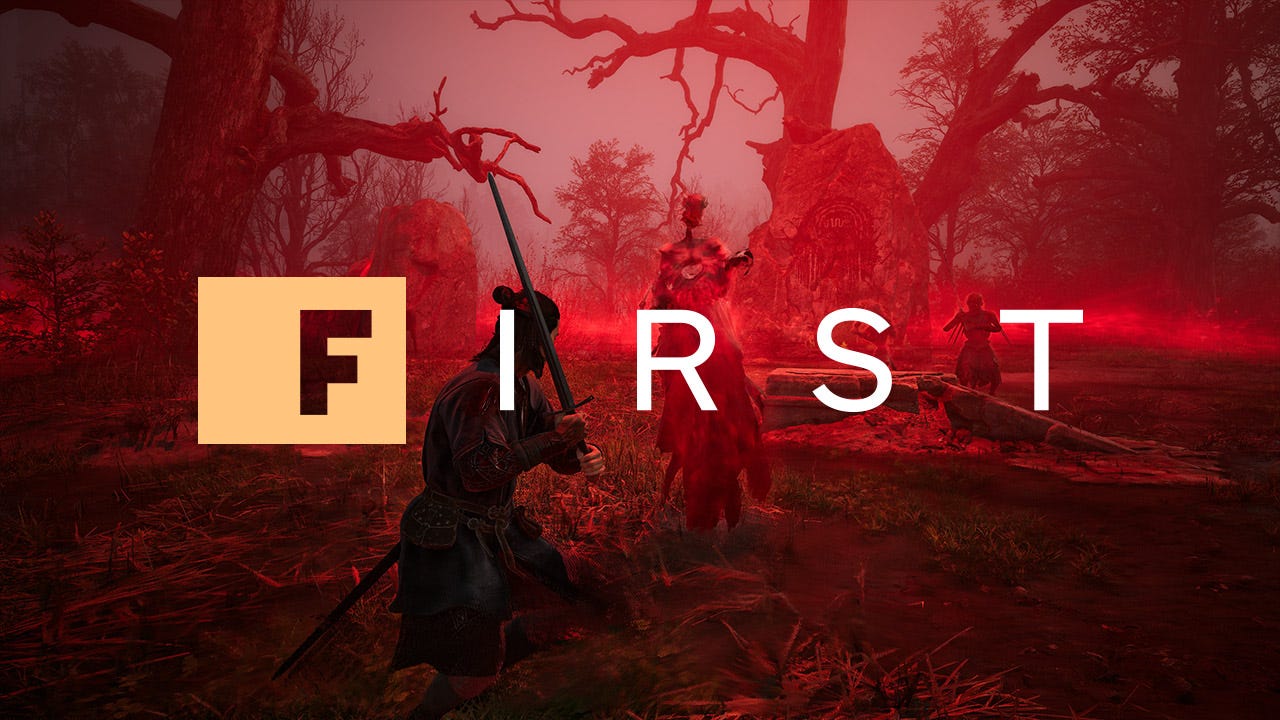
All of those errands involved Dawnwalker’s unusual combat system, which is fully directional akin to games like For Honor and Kingdom Come: Deliverance. When an enemy swings their sword from the left, you push the right analogue stick to move your blade to meet theirs. When your foe guards low, you hoist your weapon above your head and strike downwards. It’s a little tricky to master and demands a lot of concentration. Thankfully, you can effectively break down the system into pieces and graduate through it – by tapping just the block or attack button, Coen will strike or defend from all angles at the cost of more stamina. You can start there and, when you’ve become confident, begin to introduce the directional elements, and later finally start tapping the block button at the last second to score some very satisfying perfect parries.
When it all comes together, there’s a real rhythm to the combat, especially in single opponent duels. But an unexpected blow or additional assailant joining the melee could easily knock me out of that rhythm, and the consequences were fatal. It’s very difficult to heal mid-battle – I was exploring at night, and so had access to my vampire abilities, but the neck-chomping ability only restores Coen’s health by a small fraction, and its cool down feels like an eternity when you’re on the knife-edge between life and death. Combine this with enemies that all feel like they have health pools 15% too deep, and repeat encounters against six or so soldiers at a time, and I found the combat system’s strong foundations eventually became arduous. It feels like a little balancing may be needed in this regard ahead of its September 3 launch. Later inventory items and unlocks may well balance all this out, and no doubt experience will sharpen your skills, but by the end of my hour in the open world I was feeling fairly burnt out on Dawnwalker’s swordplay.
Depending on the situation, there are options to mitigate the amount of slaughter. The demo concluded at a large fortified encampment, its gate guarded by a stern nightshift soldier who refused to let me in. I tore his neck apart in response, resulting in a gauntlet of battles that I found insurmountable. Searching for alternative methods, I tried to use Coen’s Shadowstep ability to teleport to a rooftop inside the courtyard and bypass the guards, but this simply triggered the combat encounter – Dawnwalker really isn’t a stealth game, so don’t expect any sneaky infiltrations and silent backstabs. However, I later learned from the developers that there is a backdoor that allows quiet entry into the camp. Even better, if I’d returned the next morning, the day shift guards may even have let me in. It’s these kinds of options that I look forward to discovering when I can finally play The Blood of Dawnwalker without a four-hour timer.
That’s not to say I want to avoid combat entirely. The fundamentals of battle are strong, and while the demo’s later encounters felt drawn out thanks to numerous assailants with high HP, there’s every chance that improved balancing or further experience with the systems may wash those worries away. But even if swordplay remains iffy… well, that was the thorn in The Witcher 3’s side, wasn’t it? And so it’s the quality of the quests, the writing, and that “time as a resource” structure that interests me most. And, after having experienced it all for myself, I remain confident that The Blood of Dawnwalker is the next RPG worth paying very close attention to.
Matt Purslow is IGN’s Executive Editor of Features.